The Best Coffee Gear Under $30 That’s Actually Worth Buying
As an Amazon Associate, Slow Pour Lab earns from qualifying purchases. Links on this page may earn us a small commission at no cost to you.
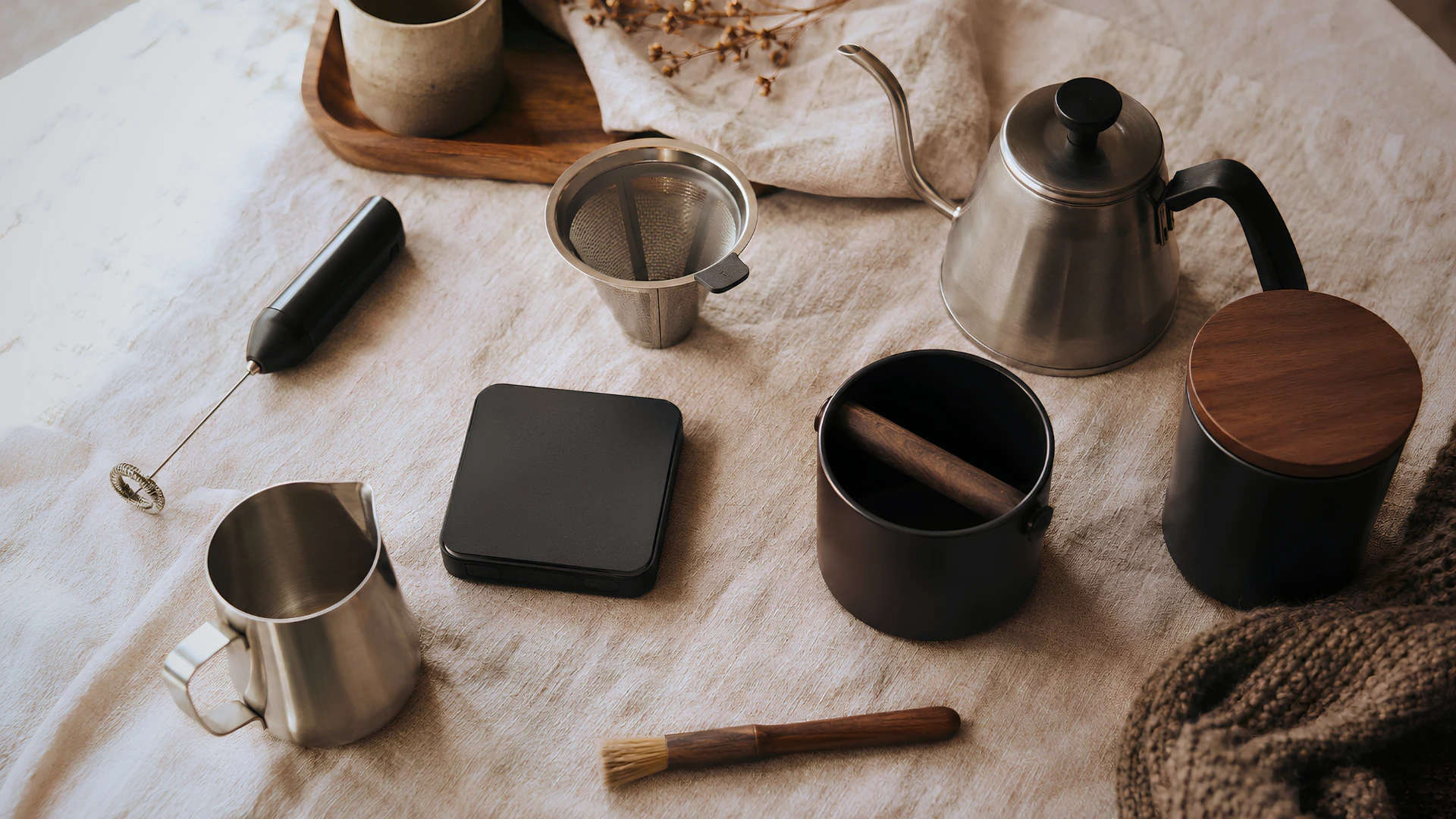
Most “cheap coffee gear” lists are padded with junk, like novelty mugs, gimmick gadgets, and accessories that solve a problem nobody has. This isn’t that. These are the inexpensive items that show up again and again in owner reviews and expert recommendations because they genuinely change the daily cup, not because they’re cheap enough to fill out a list.
Eight items, all under $30 at the time of writing. Prices on Amazon move constantly, so treat the bands here as a guide and check the live price before you buy. For each item: what it does, what to look for, the pick, and what to skip.
The short answer
| Item | What it does | Price band | Skip if… |
|---|---|---|---|
| Handheld milk frother | Foam for lattes without a machine | $10–20 | You only drink black coffee |
| Digital coffee scale | Makes your brew repeatable | $15–30 | You already own a 0.1g scale |
| Reusable metal filter | Ends paper filter buying forever | $10–20 | You prefer a cleaner, paper-filtered cup |
| Gooseneck kettle (stovetop) | Controlled pour for pour-over | $25–30 | You don’t brew pour-over |
| Coffee storage canister | Keeps beans fresh longer | $25–35 | You buy beans weekly in small amounts |
| Knock box | Somewhere to dump spent grounds | $10–20 | You don’t pull espresso |
| Cleaning brush set | Keeps grinder and group head clean | $10–15 | Never (everyone needs this) |
| Milk pitcher | Pours better foam, enables latte art | $12–20 | You don’t froth milk |
All links below are affiliate links. Picks and reasoning follow.
How I picked these
Same method as everything on Slow Pour Lab: I read through owner reviews on Amazon, cross-referenced recommendations from coffee-focused sources, and filtered for items that hold up past the first few months of use. Cheap gear is where reviews matter most. The failure rate on $12 gadgets is high, and the difference between a frother that lasts two years and one that dies in a month is usually visible in the review history, not the product description.
I don’t take paid placements and I don’t recommend something just because it’s affordable. A few of these have a “spend more if you want” option noted, but everything in the main list earns its spot under $30.
1. Handheld milk frother
The cheapest way to make café-style drinks at home. A handheld frother whips air into warm milk to create foam for lattes, cappuccinos, and matcha, with no espresso machine required. It won’t produce the tight microfoam a real steam wand does, but for the price it’s the single highest-impact upgrade for anyone who drinks milk-based coffee.
What to look for:
- Rechargeable (USB-C) over battery. Battery models work, but you’ll be replacing AAs constantly. A rechargeable model is more convenient and usually more powerful.
- High RPM. The better models spin fast enough to foam oat and soy milk, not just dairy. Look for owner reviews that mention non-dairy performance if that matters to you.
- A stand or case. Keeps it off the counter and the whisk clean.
The pick: A rechargeable handheld frother in the $15–20 band from a brand with a long review history (Zulay and the Keurig SimpleCafe are both commonly recommended and frequently on sale). Avoid the unbranded $6 models. They foam fine for a few weeks, then the motor weakens.
What to skip: Battery-only frothers if you’ll use it daily, and anything bundled with a “free” frothing cup that inflates the price.
2. Digital coffee scale
If you don’t already own a 0.1g scale, this is the best $20 you’ll spend on coffee. Brewing by eye is the main reason home coffee tastes inconsistent. A scale lets you hit the same coffee-to-water ratio every time, which is what separates a good cup from a lucky one.
What to look for:
- 0.1g resolution. Standard kitchen scales read in whole grams, which isn’t precise enough for coffee.
- Built-in timer. Useful for pour-over and espresso timing.
- Flat, compact profile so it fits on a brewing setup.
The pick: Any well-reviewed 0.1g scale with a timer in the $15–25 band. This is a near-commodity category. The budget KitchenTour and similar models all perform well. If you want a nicer scale for pour-over specifically, the step-up options run higher, but they’re not necessary here.
What to skip: “Smart” app-connected scales at this price (the app adds nothing), and 1g-resolution kitchen scales.
3. Reusable metal filter
A one-time buy that ends paper filter purchases forever and changes the cup in the process. Metal filters let more of the coffee’s oils through, producing a heavier, fuller body than paper. Whether that’s better is a matter of taste. Some people love it, some prefer paper’s cleaner cup.
What to look for:
- Match it to your brewer. A V60-shaped metal filter won’t fit a flat-bottom brewer. Buy for the device you own.
- Fine mesh. Cheaper mesh lets through more sediment. Owner reviews will tell you which run muddy.
The pick: A stainless mesh filter sized to your specific pour-over cone or French press, $10–20.
What to skip: Gold-plated “premium” filters. The coating adds cost, not performance.
4. Gooseneck kettle (stovetop)
If you brew pour-over, the gooseneck spout is what gives you control over where and how fast the water lands, which controls the entire extraction. You don’t need an electric variable-temperature model to start; a stovetop gooseneck does the job for under $30.
What to look for:
- A genuine narrow gooseneck spout, not a slightly-tapered regular spout.
- A comfortable handle that stays cool.
- A built-in thermometer is a bonus but not essential at this price.
The pick: A stovetop gooseneck kettle in the $25–30 band. The electric variable-temp kettles (Fellow Stagg and similar) are excellent but run well over budget. Worth it later, not necessary now.
What to skip: Tiny travel goosenecks unless you specifically want one for travel; they hold too little for a full brew.
5. Coffee storage canister
Beans go stale from exposure to oxygen, light, and moisture. An airtight canister slows that down and keeps beans tasting fresh for noticeably longer than the bag they came in. At this price you’re getting a good airtight seal, not a vacuum pump. That’s fine for most people who finish a bag within a few weeks.
What to look for:
- A genuine airtight seal (silicone gasket, latching lid).
- Opaque or tinted to block light. Clear glass looks nice but lets light in.
- Sized to your habit — a canister that holds about a pound suits most.
The pick: An airtight latching canister in the $25–35 band (the Planetary Design Airscape is the most commonly recommended in this range. It has a plunger lid that pushes air out).
What to skip — gently: The Fellow Atmos is the popular vacuum-sealed option, but it runs around $60, well over this list’s budget. It’s genuinely nice, just not a sub-$30 pick. If freshness is a priority and you finish bags slowly, it’s worth considering separately.
6. Knock box
If you pull espresso, this is where you dump the spent puck. You’ll do it every single day, and knocking pucks into the trash gets old fast. It’s a boring purchase that quietly makes the daily routine better.
The pick: A standard rubber-rimmed knock box in the $10–20 band. They’re nearly all the same. Look for a removable knock bar and a non-slip base.
What to skip: Anything over $40, and oversized boxes that hog counter space.
7. Cleaning brush set
The least exciting item here and one of the most useful. Coffee grinders and espresso group heads accumulate oils and old grounds that turn rancid and taint flavor. A cheap brush set keeps everything clean, and there’s no reason not to own one.
The pick: A coffee cleaning brush set in the $10–15 band usually includes a grinder brush and a group-head brush.
What to skip: Nothing. Everyone with a grinder needs this. Just don’t overpay.
8. Milk pitcher
If you froth milk, a proper spouted pitcher pours far better than frothing straight in a mug, and it’s what makes any attempt at latte art possible. Covered in more detail in our espresso starter guide, but it belongs on any under-$30 list too.
What to look for:
- 12oz for one drink, 20oz for two.
- A spout, not a flat lip.
- Stainless steel, no coatings.
The pick: A 12oz spouted stainless pitcher, $12–20. The cheap ones are functionally identical to the expensive ones at this size.
What to skip: Plastic pitchers and anything non-stick coated.
What to skip entirely
A few popular “cheap coffee gear” items that aren’t worth the money:
Single-serve pour-over drippers that sit on the mug. Fine in a pinch, but you’ll outgrow them in a week. Spend slightly more on a real cone.
Branded cleaning tablets at triple the price. Generic descaling solution and espresso-machine cleaning tablets work the same as branded ones. Don’t pay for the logo.
Novelty “barista kits” that bundle a cheap frother, a tiny tamper, and a thin pitcher. The individual items in this list are better and often cost the same combined.
What’s the single best cheap coffee upgrade?
A digital scale if you don’t have one, or a handheld frother if you drink milk-based coffee. Both are under $25 and both visibly change the daily cup. The scale by making your brew consistent, the frother by turning plain coffee into a latte.
Is a cheap coffee scale really good enough?
Yes. Scales are close to a commodity. A $20 0.1g scale with a timer does the same core job as a $200 one. The expensive models add durability, faster response, and features that matter to obsessives, not to someone getting started.
Do reusable metal filters make better coffee than paper?
Different, not strictly better. Metal lets more oils through for a heavier body. Paper gives a cleaner, brighter cup. It comes down to taste, and at $15 a metal filter is cheap enough to try.
Are the unbranded $6 frothers worth it?
For occasional use, sure. For daily use, no. The motors weaken within weeks. Spend the extra $10 on a rechargeable model with a long review history and it’ll last years.
What cheap coffee gear should I avoid?
Mug-top single-serve drippers, branded cleaning tablets sold at a premium over identical generics, and bundled “barista kits” that combine several low-quality items. Buy the individual pieces that are actually good instead.